One of my favorite ELT activities is the sound sequence. Here's how it works: Students hear a series of sound effects, then work in groups to produce a story based on the sound effects. A very simple, yet engaging way of getting students to produce an inventive story. I'm always amazed by the variety of stories conjured up by different groups.
Sound sequences first appeared in two books by Alan Maley and Alan Duff, with the brilliant titles Sounds Interesting and Sounds Intriguing. They came with a cassette of sound effects for the activities in the book. Unfortunately, these Cambridge University Press titles from the 70's are long out of print. Mario Rinvolucri wrote up an unplugged version of a sound sequence, published over a decade ago in Humanising Language Teaching, which you can see here. He also included a sound sequence titled "From Sounds to Mumblings to Stories" in the book Imagine That!, which he co-authored with Jane Arnold and Herbert Puchta. This book included an audio CD with the sound effects for the exercise.
What I want to know is, WHY hasn't anyone created a website with a collection of sound sequence podcasts? I think this would be a fantastic project for some hardworking podcaster out there.
For teachers who want to use sound sequences in their own classes, I can think of a few options. One is to follow the advice of Mario Rinvolucri in the article linked above, and create your own sound effects live. (Perhaps if you excel at this you might consider a second career as a foley artist.)
You can purchase CDs of sound effects such as this one, which contains hundreds of sound effects.
Another choice is to go online and find sound effects websites where you can download sounds for free. Here are a few examples:
A1 Free Sound Effects
Partners in Rhyme
PacDV Free Sound Effects
Now, a few random (very random) sound sequences I generated, using descriptions of the sound effects on the websites mentioned above.
striking a match...knocking...kisses...climbing wooden stairs...crowd cheering
horse gallop...scream...footsteps...glass breaking...snore...police arrive
elevator...fax...sneeze...machine gun...maniacal laughter
lion roar... pour drink with ice...wolf whistle...camera click...slap
Some questions:
Which of these four sequences do you think is the best? Can you think of a better arrangement of the sounds?
In terms of designing a sound sequence, should the sounds be put in an order that obviously tells a story (footsteps, knock on door, door opens, scream, gunshot) or should the order be made to challenge students (bird song, typewriter, laugh, toilet flush)? Should sound sequences include mostly sounds that are easily identifiable, or mostly sounds that are open to interpretation? And what is the optimum number of sounds in a sound sequence?
Tuesday, January 19, 2010

Wednesday, January 13, 2010
Calling on students randomly
While reading Teaching Unplugged by Scott Thornbury and Luke Meddings, I came across the following set of instructions in a fun activity called Best in 24:
Give everyone in the room, including yourself, a number. Roll the dice and ask the person corresponding to the number that comes up: What's the nicest thing you ate or drank in the last 24 hours?
I thought this over and realized there were two small flaws to this procedure.
First of all, this could be rather unwieldy in a large or extra large class. I have taught classes of 120 students before, and I can't imagine rolling 20 dice and counting up the numbers while students wait. However, I'm sure that Thornbury and Meddings intended this activity for more ideal class sizes.
Secondly, and more importantly, I wondered if rolling 2 or 3 dice and assigning numbers might make certain students more likely to be called on. I checked with a website called The Wizard of Odds, and realized that I was right. When rolling two dice, you are far more likely to roll a 6, 7 or 8, than a 2 or 12. And when rolling 3 dice, you will get a 9, 10, 11, or 12 more often than a 3 or an 18. In addition, when rolling two dice the number 1 never comes up, and with three dice, 1 and 2 never come up.
A solution? I have a few ideas for improving these instructions. One solution might be to use the odds for your own devious purposes. For example, give students who hardly ever speak out the numbers that you are more likely to roll, and give students who dominate the class the numbers you are less likely to roll.
If you want to get a real random number, you can use a random number generator. Random.org has a random number generator that is easy to use. Type in the range and click to get a random number instantly.
Another solution is to write everyone's name on index cards (or blank business cards) and shuffle them. This is probably the easiest solution, as you can make the cards once and use them many times.
One more (not so random) technique is to get a student to choose a second student to answer the question. This can be made more interesting by demanding that a student give a valid reason for passing the question on to a second student. If you think the reason is good enough, the second student must answer the question. If you think the reason is unacceptable, then the question goes to the first student. My students have come up with some pretty clever reasons!
Can you think of any other ways to call on students randomly that I haven't mentioned here?
Give everyone in the room, including yourself, a number. Roll the dice and ask the person corresponding to the number that comes up: What's the nicest thing you ate or drank in the last 24 hours?
I thought this over and realized there were two small flaws to this procedure.
First of all, this could be rather unwieldy in a large or extra large class. I have taught classes of 120 students before, and I can't imagine rolling 20 dice and counting up the numbers while students wait. However, I'm sure that Thornbury and Meddings intended this activity for more ideal class sizes.
Secondly, and more importantly, I wondered if rolling 2 or 3 dice and assigning numbers might make certain students more likely to be called on. I checked with a website called The Wizard of Odds, and realized that I was right. When rolling two dice, you are far more likely to roll a 6, 7 or 8, than a 2 or 12. And when rolling 3 dice, you will get a 9, 10, 11, or 12 more often than a 3 or an 18. In addition, when rolling two dice the number 1 never comes up, and with three dice, 1 and 2 never come up.
A solution? I have a few ideas for improving these instructions. One solution might be to use the odds for your own devious purposes. For example, give students who hardly ever speak out the numbers that you are more likely to roll, and give students who dominate the class the numbers you are less likely to roll.
If you want to get a real random number, you can use a random number generator. Random.org has a random number generator that is easy to use. Type in the range and click to get a random number instantly.
Another solution is to write everyone's name on index cards (or blank business cards) and shuffle them. This is probably the easiest solution, as you can make the cards once and use them many times.
One more (not so random) technique is to get a student to choose a second student to answer the question. This can be made more interesting by demanding that a student give a valid reason for passing the question on to a second student. If you think the reason is good enough, the second student must answer the question. If you think the reason is unacceptable, then the question goes to the first student. My students have come up with some pretty clever reasons!
Can you think of any other ways to call on students randomly that I haven't mentioned here?
Wednesday, January 06, 2010
New discussion at Think Tank (ELT News)
This new article from ELT News Think Tank Panel got me smiling. I really enjoyed Marc Helgesen's idea about how to end a class properly.
http://www.eltnews.com/features/thinktank/
http://www.eltnews.com/features/thinktank/
Friday, January 01, 2010
Thinking Skills and CLIL
Over at the One Stop English website, Jean Brewster has contributed this article on thinking skills in CLIL:
http://www.onestopclil.com/section.asp?docid=1197&catid=317
It includes a clear introduction to Bloom's Taxonomy, as well as some examples of how thinking skills fit into CLIL lessons. Teachers interested in this topic might also want to look at my new book, Provoking Thought: Memory and Thinking in ELT.
http://www.onestopclil.com/section.asp?docid=1197&catid=317
It includes a clear introduction to Bloom's Taxonomy, as well as some examples of how thinking skills fit into CLIL lessons. Teachers interested in this topic might also want to look at my new book, Provoking Thought: Memory and Thinking in ELT.
Wednesday, December 30, 2009
Scott Thornbury video and blog
A few months ago I posted about some teacher development videos I found interesting. I have discovered this recent lecture from Scott Thornbury about grammar:
Seven Ways of Looking at Grammar
Also, I highly recommend Scott Thornbury's new blog, which related to entries in his book, An A-Z of ELT:
An A-Z of ELT - Scott Thornbury's Blog
Very lively discussion in the comments sections.
Seven Ways of Looking at Grammar
Also, I highly recommend Scott Thornbury's new blog, which related to entries in his book, An A-Z of ELT:
An A-Z of ELT - Scott Thornbury's Blog
Very lively discussion in the comments sections.
Monday, December 07, 2009
9 variations of brainstorming
Brainstorming is an activity that's not new to ELT. It's a superb way to motivate students to work on all four skills, talking (or writing) about real topics and working towards solutions. Well-known ELT professionals, such as Natalie Hess, Rose Senior, Jane Willis and Dave Willis have all written about its strengths as a language learning activity. I've written here and here about the basic rules of brainstorming and how to have a successful brainstorming session. (In addition I can recommend JVC's excellent article, The Step by Step Guide to Brainstorming)
Today I'd like to share with you 9 different formats for brainstorming, each one with its own unique characteristics.
Brainwriting - Participants write ideas on slips of paper, then pass the slips of paper to others who can add comments. Ideal for classes that prefer to discuss through writing.
Brainwalking - Similar to brainwriting, but in this case, students write on large sheets of paper covering the walls. Each sheet of paper has a topic related to your problem, and students can walk around and add comments. This one is highly suitable for kinesthetic students who don't want to spend the whole class sitting down.
Imaginary Brainstorming - Here, you create a problem statement and give a traditional brainstorming session. Then, everyone suggests changes to some of the words to create a new problem statement, ideally one that is off-the-wall and bizarre. Brainstorm again and make a list of solutions. Now apply these solutions to your original problem.
Rawlinson Brainstorming - Unlike most ideas here, this one does not emphasize group interaction. One person presents his or her problem and the ideal situation he or she is looking for. Other group members present their solutions directly to the presenter in two-word phrases. The presenter focuses on the ideas that he or she finds most helpful.
Visual Brainstorming - Group members sketch solutions to a problem. The sketches are used as a springboard for more solutions. This variation will appeal to visual learners, as well as learners with artistic inclinations.
Negative Brainstorming - Participants begin with a problem statement that is the opposite of their goal (ex. How can we go out of business? or How can we make our workplace more depressing?). They brainstorm a number of ideas. Ultimately, they use their ideas as a springboard to more realistic and useful solutions to their actual problem statement.
Didactic Brainstorming - Begin with a question that is an abstract version of your problem statement (ex. What is beauty?). Get participants to discuss for a few minutes, and come up with a variety of answers. Then reveal your true problem statement (ex. How can we improve the appearance of our staff room?). This approach might appeal to more philosophical learners.
Rolestorming - Create a set of roles for a role play that represents a problem statement. Ask students to perform their role plays in groups. Next students will write down any solutions that came to mind as they watched and performed in the role plays.
Value Brainstorming - Ask the group to make a list of primary concerns regarding their problem statement. Then ask them to make a list of some of the hidden values behind these concerns. Participants should rank these values and clarify their meaning. Finally, the group should suggest solutions based on these values.
The Mycoted website has many more creativity exercises that are ideal for the classroom.
Today I'd like to share with you 9 different formats for brainstorming, each one with its own unique characteristics.
Brainwriting - Participants write ideas on slips of paper, then pass the slips of paper to others who can add comments. Ideal for classes that prefer to discuss through writing.
Brainwalking - Similar to brainwriting, but in this case, students write on large sheets of paper covering the walls. Each sheet of paper has a topic related to your problem, and students can walk around and add comments. This one is highly suitable for kinesthetic students who don't want to spend the whole class sitting down.
Imaginary Brainstorming - Here, you create a problem statement and give a traditional brainstorming session. Then, everyone suggests changes to some of the words to create a new problem statement, ideally one that is off-the-wall and bizarre. Brainstorm again and make a list of solutions. Now apply these solutions to your original problem.
Rawlinson Brainstorming - Unlike most ideas here, this one does not emphasize group interaction. One person presents his or her problem and the ideal situation he or she is looking for. Other group members present their solutions directly to the presenter in two-word phrases. The presenter focuses on the ideas that he or she finds most helpful.
Visual Brainstorming - Group members sketch solutions to a problem. The sketches are used as a springboard for more solutions. This variation will appeal to visual learners, as well as learners with artistic inclinations.
Negative Brainstorming - Participants begin with a problem statement that is the opposite of their goal (ex. How can we go out of business? or How can we make our workplace more depressing?). They brainstorm a number of ideas. Ultimately, they use their ideas as a springboard to more realistic and useful solutions to their actual problem statement.
Didactic Brainstorming - Begin with a question that is an abstract version of your problem statement (ex. What is beauty?). Get participants to discuss for a few minutes, and come up with a variety of answers. Then reveal your true problem statement (ex. How can we improve the appearance of our staff room?). This approach might appeal to more philosophical learners.
Rolestorming - Create a set of roles for a role play that represents a problem statement. Ask students to perform their role plays in groups. Next students will write down any solutions that came to mind as they watched and performed in the role plays.
Value Brainstorming - Ask the group to make a list of primary concerns regarding their problem statement. Then ask them to make a list of some of the hidden values behind these concerns. Participants should rank these values and clarify their meaning. Finally, the group should suggest solutions based on these values.
The Mycoted website has many more creativity exercises that are ideal for the classroom.
Thursday, December 03, 2009
new article on Web 2.0
I really enjoyed this new article by Cristina Arnau Vilà, an EFL teacher in Spain:
http://www.hltmag.co.uk/dec09/mart02.htm
A clear introduction to Web 2.0, as well as many fascinating links (warning: you'll probably spend a few hours on the computer after reading this article!) Great stuff!
http://www.hltmag.co.uk/dec09/mart02.htm
A clear introduction to Web 2.0, as well as many fascinating links (warning: you'll probably spend a few hours on the computer after reading this article!) Great stuff!
Thursday, November 26, 2009
The book is out!
After a long wait, my second book, Provoking Thought, is now in print. I received my first copy a few days ago through the mail, and it is available through Amazon. I'm looking forward to seeing how my title does on Amazon.
You can see here a picture of me with my book, standing in the hallway outside the Department of Applied English at Kainan University.
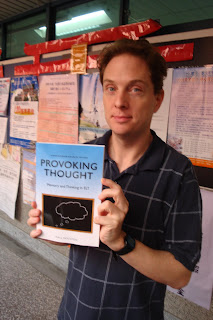
You can see here a picture of me with my book, standing in the hallway outside the Department of Applied English at Kainan University.
Thursday, November 19, 2009
two ads for Provoking Thought
In order to promote my new book, PROVOKING THOUGHT, I've put together a couple of short ads to get the word out. Here they are:
Provoking Thought ad 1
Provoking Thought ad 2
(Thanks to www.grapheine.com/bombaytv and www.grapheine.com/classiktv for their assistance with the two ads!)
Provoking Thought ad 1
Provoking Thought ad 2
(Thanks to www.grapheine.com/bombaytv and www.grapheine.com/classiktv for their assistance with the two ads!)
Wednesday, November 11, 2009
Creativity in ELT
Last night, I discovered this wonderful article on creativity and teaching:
The art of being creative
written by Marisa Constantinides. A well-written piece on how we can develop into more creative teachers. If you are interested in teacher training, you might also want to read her blog post over at Kalinago English:
How to Become an ELT Teacher Educator
The art of being creative
written by Marisa Constantinides. A well-written piece on how we can develop into more creative teachers. If you are interested in teacher training, you might also want to read her blog post over at Kalinago English:
How to Become an ELT Teacher Educator
Tuesday, November 10, 2009
Positive Psychology and ELT
I found a link to the following site on ELT News:
ELT and the Science of Happiness
which contains some interesting reading and activities. It's the creation of Marc Helgesen. I'm always looking for activities that involve an element of psychology, so I think this will be worth trying out in some of my classes.
ELT and the Science of Happiness
which contains some interesting reading and activities. It's the creation of Marc Helgesen. I'm always looking for activities that involve an element of psychology, so I think this will be worth trying out in some of my classes.
Saturday, October 03, 2009
Book preview
Humanising Language Teaching webzine has just published a book preview of my new book, Provoking Thought. It contains a brief description of the book, along with 6 activities. Take a look:
http://www.hltmag.co.uk/oct09/teach.htm
http://www.hltmag.co.uk/oct09/teach.htm
Friday, August 28, 2009
a couple of interesting things
I haven't added much to this blog lately, so I thought I'd post a couple of links that caught my eye.
The first is about a talk given by Ben Goldstein in April 2009 on the topic of "Breaking Taboos":
http://www.bengoldstein.es/blog/2009/04/breaking-taboos/
I'm sorry I missed the talk, but the handout and powerpoint are quite informative.
I also enjoyed this interview with Karenne Sylvester on TEFL Tradesman blog (Sandy McManus) :
http://tefltradesman.blogspot.com/2009/08/karenne-kalinago-answers-six-questions.html
I especially enjoyed her eloquent answer to question #6, What's wrong with the TEFL industry?
I'm now back in Taiwan, finishing up work on my second book. More on this subject next month.
The first is about a talk given by Ben Goldstein in April 2009 on the topic of "Breaking Taboos":
http://www.bengoldstein.es/blog/2009/04/breaking-taboos/
I'm sorry I missed the talk, but the handout and powerpoint are quite informative.
I also enjoyed this interview with Karenne Sylvester on TEFL Tradesman blog (Sandy McManus) :
http://tefltradesman.blogspot.com/2009/08/karenne-kalinago-answers-six-questions.html
I especially enjoyed her eloquent answer to question #6, What's wrong with the TEFL industry?
I'm now back in Taiwan, finishing up work on my second book. More on this subject next month.
Tuesday, June 16, 2009
More videos
I've discovered some new videos teachers out there might want to take a look at.
Here's Lindsay Clandfield talking about his books and his career:
http://www.youtube.com/watch?v=PlrH0o0bGpk
and this clip features Scott Thornbury and Luke Meddings describing their new book, Teaching Unplugged:
http://www.youtube.com/watch?v=MyMSeuvShJo
Gavin Dudeney and Nicky Hockly, the arch-enemies of hardline Dogme teachers the world over, explain here why technology is not SO evil:
http://www.youtube.com/watch?v=DsaROgjoQQI
Duncan Foord can be seen here talking about his book, The Developing Teacher:
http://www.youtube.com/watch?v=mo2jlBisMDo
Finally, here's Mario Rinvolucri letting us know about the future of English language teaching:
http://www.youtube.com/watch?v=kC13wAsCHLk
Here's Lindsay Clandfield talking about his books and his career:
http://www.youtube.com/watch?v=PlrH0o0bGpk
and this clip features Scott Thornbury and Luke Meddings describing their new book, Teaching Unplugged:
http://www.youtube.com/watch?v=MyMSeuvShJo
Gavin Dudeney and Nicky Hockly, the arch-enemies of hardline Dogme teachers the world over, explain here why technology is not SO evil:
http://www.youtube.com/watch?v=DsaROgjoQQI
Duncan Foord can be seen here talking about his book, The Developing Teacher:
http://www.youtube.com/watch?v=mo2jlBisMDo
Finally, here's Mario Rinvolucri letting us know about the future of English language teaching:
http://www.youtube.com/watch?v=kC13wAsCHLk
Friday, May 22, 2009
Creativity in the News
According to a recent article, there is a connection between living abroad and creativity.
http://www.economist.com/science/displaystory.cfm?story_id=13643981
This article was published in the Economist and cites research from the Journal of Personality and Social Psychology.
http://www.economist.com/science/displaystory.cfm?story_id=13643981
This article was published in the Economist and cites research from the Journal of Personality and Social Psychology.
Wednesday, May 06, 2009
Conference presentation
Later this month, I will be presenting at Kainan University's 2009 National Conference on ESP. The topic of my presentation will be "Fostering Fluency In English Through Brainstorming". This will be my very first conference presentation.
For more about the conference, follow this link:
http://www.knu.edu.tw/AE/conference2009/2009Agenda2.jpg
For more about the conference, follow this link:
http://www.knu.edu.tw/AE/conference2009/2009Agenda2.jpg
Sunday, April 26, 2009
ELT Weekly
Recently I've discovered a new periodical for ESL/EFL teachers. It's called ELT Weekly, and it's described as "India's first weekly ELT e-newsletter".
http://www.eltweekly.com
Some interesting content, including articles, ELT news and events and weekly features, such as book of the week, ELT blog of the week, and even ELT cartoon of the week.
This week's edition features a new article I wrote, titled "A Creative Approach to Lesson Planning". You can see the article here:
http://eltweekly.com/more/2009/04/25/eltweekly-issue17-article-a-creative-approach-to-lesson-planning-by-hall-houston/
I would also recommend you read Mario Rinvolucri's blog, featured as this week's ELT blog of the week.
http://www.eltweekly.com
Some interesting content, including articles, ELT news and events and weekly features, such as book of the week, ELT blog of the week, and even ELT cartoon of the week.
This week's edition features a new article I wrote, titled "A Creative Approach to Lesson Planning". You can see the article here:
http://eltweekly.com/more/2009/04/25/eltweekly-issue17-article-a-creative-approach-to-lesson-planning-by-hall-houston/
I would also recommend you read Mario Rinvolucri's blog, featured as this week's ELT blog of the week.
Monday, April 13, 2009
The Speaking Cyclist
I came across this new blog from Mark Lloyd the other day:
http://thespeakingcyclist.blogspot.com/
It features speaking lessons he refers to as "speaking cycles". The approach is loosely based on the idea of Dogme ELT. There are already 7 cycles up on the site, and they're quite well written. I'm hoping to try some of these out in my lessons this month.
http://thespeakingcyclist.blogspot.com/
It features speaking lessons he refers to as "speaking cycles". The approach is loosely based on the idea of Dogme ELT. There are already 7 cycles up on the site, and they're quite well written. I'm hoping to try some of these out in my lessons this month.
Monday, March 23, 2009
Videos for professional development
Usually, I tend to think of Youtube videos as teaching material for EFL courses. Recently, I've discovered a number of videos aimed at teachers. I will share a few of these here:
Macmillan has over 30 videos for ELT teachers, including some excellent presentations by big names such as Scott Thornbury and Lindsay Clandfield:
http://www.youtube.com/user/macmillanELT
On another website, there is a nice series of short videos of Zoltan Dörnyei, with the title "Motivation in the language learning classroom DVD":
http://www.scilt.stir.ac.uk/motivation/zoltan.php
This was a wonderful discovery for me, since I'm currently reading his book, Motivation Strategies in the Language Classroom. The videos are helping me review the contents of his book.
The University of Oregon has a series of videos titled Shaping the Way We Teach English, introducing a series of important topics, such as contextualizing language, building language awareness, and integrating skills. Here's module 1:
http://www.youtube.com/watch?v=Qu2JRqTdtGQ&feature=related
Madridteacher has some some very clever tips on teaching. Here's his video on how to teach interesting English classes:
http://www.youtube.com/watch?v=kjJnki6WZe0
These final two are about language in general. There's an entertaining video of Steven Pinker talking about language at Google:
http://www.youtube.com/watch?v=hBpetDxIEMU&feature=related
Finally, here's a video of Bill Labov talking about American English:
http://www.youtube.com/watch?v=W68VaOuY6ew
Macmillan has over 30 videos for ELT teachers, including some excellent presentations by big names such as Scott Thornbury and Lindsay Clandfield:
http://www.youtube.com/user/macmillanELT
On another website, there is a nice series of short videos of Zoltan Dörnyei, with the title "Motivation in the language learning classroom DVD":
http://www.scilt.stir.ac.uk/motivation/zoltan.php
This was a wonderful discovery for me, since I'm currently reading his book, Motivation Strategies in the Language Classroom. The videos are helping me review the contents of his book.
The University of Oregon has a series of videos titled Shaping the Way We Teach English, introducing a series of important topics, such as contextualizing language, building language awareness, and integrating skills. Here's module 1:
http://www.youtube.com/watch?v=Qu2JRqTdtGQ&feature=related
Madridteacher has some some very clever tips on teaching. Here's his video on how to teach interesting English classes:
http://www.youtube.com/watch?v=kjJnki6WZe0
These final two are about language in general. There's an entertaining video of Steven Pinker talking about language at Google:
http://www.youtube.com/watch?v=hBpetDxIEMU&feature=related
Finally, here's a video of Bill Labov talking about American English:
http://www.youtube.com/watch?v=W68VaOuY6ew
Saturday, February 28, 2009
Thinking Skills in the News
Two recent news items caught my eye, as they are related to the topics of my next book (memory, creativity, critical thinking).
The first describes a study which suggests that color can affect our creativity and our attention to detail (which can help us remember):
http://dsc.discovery.com/news/2009/02/06/blue-red-effects.html
Perhaps more research of this sort could give ELT materials writers some ideas for what colors to use in their coursebooks...
The second news article mentions some research indicating that doodling could possibly help us remember things better:
http://health.usnews.com/articles/health/healthday/2009/02/27/take-note-doodling-can-help-memory.html
Hmmm, this could be an interesting idea for a vocabulary review session.
The first describes a study which suggests that color can affect our creativity and our attention to detail (which can help us remember):
http://dsc.discovery.com/news/2009/02/06/blue-red-effects.html
Perhaps more research of this sort could give ELT materials writers some ideas for what colors to use in their coursebooks...
The second news article mentions some research indicating that doodling could possibly help us remember things better:
http://health.usnews.com/articles/health/healthday/2009/02/27/take-note-doodling-can-help-memory.html
Hmmm, this could be an interesting idea for a vocabulary review session.
Subscribe to:
Posts (Atom)


 Posts
Posts


