
Michael Rost is a well-known figure in ELT. He's written and edited many excellent books on listening, including Introducing Listening, Listening in Action, and Listening in Language Learning (as well as numerous coursebooks). He's also behind a new game that will certainly appeal to teenagers and young adults. His latest book, Teaching and Researching Listening(2nd Edition), is a comprehensive overview of research in second language listening. I contacted him recently and asked him to do a guest blog post. He sent me back this superb article.
The Importance of Listening Events
by Michael Rost
I was 21 years old, fresh out of college with a teaching degree. Bouyant, confident, ready to rock and roll! I had just finished 8 weeks of intensive language teaching training in West Africa, along with daily (relentless!) French language immersion. I was champing at the bit to teach my first class at a high school in Lome, Togo.
I stood in the bright morning sunshine, and following the attedance ritual that was being modeled by my teaching colleagues, I began to call out the names of my students, one by one. They were all lined up single file, in their crisp brown and white uniforms, squinting at me, this young bearded foreigner who was supposed to be their new English teacher. I didn’t get very far. On the very first name, Ag-be-fi-ah-nu, I stumbled. In a flash, all 80 of the teenage students who were lined up began to giggle and shuffle uncomfortably. This was going to be a long awkward experience for us all.
I took a deep silent breath, letting it sink in that I had absolutely no idea what to do. In that moment, I had a simple realization. I could “pretend” to be someone else, someone who knew exactly how to handle this, or I could let them know how I really felt – new, raw, and vulnerable. I took the clipboard of names, and handed it to Mr. Agbefianu (whose name I had just butchered) and asked him to call the roll. As each student was called (in fluent Ewe) and stepped forward toward the classroom door, I looked them in the eye, shook their hand, and welcomed them to the class. It turned out to be the perfect beginning for both the school year and for my career as a teacher.
I call this kind of experience an “epiphany” – an unplanned, unexpected understanding of something important. The understanding arrives in an instant, in a flash, from somewhere we didn’t previously know existed. Like most teachers, I have had a few epiphanies during my career, and I’ve learned to trust these moments to bring me guidance, a grain of wisdom perhaps, and most certainly a dose of humility.
I think of these moments as “listening events”, because I’m somehow able to open up, to listen without expectations, and to allow myself to understand something meaningful.
Starting with that first year of my teaching career – perhaps even triggered by this opening day event – I became increasingly interested in the notion of listening events and listening more generally. To this day, some years later, I remain intrigued with listening, and the essential role it plays in learning.
Though I have deconstructed the act of listening in minute detail (see the first section of my book, Teaching and Researching Listening, which describes listening from neurological, linguistic, semantic, and pragmatic perspectives), I am still convinced that these “listening events”, experienced holistically, are central to understanding listening – and to teaching listening as a skill.
I can generate lists of “teaching tips” about listening (and have done so on numerous occasions), but if I have to boil it down to a single piece of advice, I say this: To teach listening, you simply have to create listening events, give minimal guidance, and allow real listening (not just “practice listening”) to happen!
What is a listening event? I think three factors are always evident. One, it is a “high stakes situation” in which a participant – whom we’ll call the listener – experiences an initial confusion or frustration or a misunderstanding of what’s taking place and converts this to a need to undertand. Two, the listener needs to be “invested”: the situation has to be important enough that the listener’s “emotions run high.” Because of the emotional intensity, three, the listener becomes “present”, and activates a heightened sensory awareness to achieve an understanding of what is going on.
Without investment, there is no involvement. And without involvement, there is no cognitive or emotional engagement. The listener is just going through the motions, “practicing” listening – something all teachers have witnessed many a time. Note for the record: I have nothing against “practicing” – practice is essential for sustaining progress – but these listening events are more important in the grand scheme of things. They serve as “triggers” that develop and sustain a learner’s motivation.
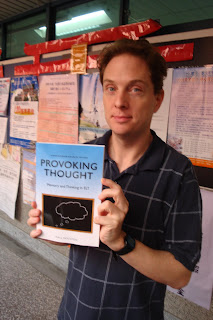
Listening events are not difficult to set up. Ideas that have worked for me: values clarification exercises (see Hall Houston’s Provoking Thought, Chapter 4, for numerous ideas), watching emotional speeches (see americanrhetoric.com for some inspiring examples; check out the “Movie Speeches” for some great moments), and “high-stakes conversations” (see Eric Roth and Toni Aberson’s Compelling Conversations Section 1 for launchpad ideas).
There are lots of methodology tips and techniques to employ to get the most out of listening events. (I outline some approaches in Section 3 of Teaching and Researching Listening.) But most teachers, trusting their own instincts and informed by their own teaching epiphanies, are likely not to need detailed suggestions for making listening events work. The key is the right starting point, the right perspective. As I discovered in my first language teaching job, it’s OK not to be an expert, it’s OK not to know. In fact, some of our greatest insights – even epiphanies – come when we let ourselves “not know”.
-Michael Rost (7 April 2011)



 Posts
Posts


