Yup, it's true, I couldn't make the legendary 2010 IATEFL conference in Harrogate, although I've caught a few glimpses of what I missed here and there on the web.
One presentation in particular interested me was about teaching creative skills in EFL. Marisa Constantinides put the abstract, summary, notes and power point for her presentation titled "Embedding Creating Thinking Skills Training into our EFL Practice" up on her blog. Some good background on creativity, as well as a lot of practical ideas for teaching.
What about you? If you attended, which presentations would have impressed me the most?
Friday, April 16, 2010

Monday, March 29, 2010
Reviews, promotion for Provoking Thought
My second book, Provoking Thought, was published in late 2009. It's a collection of over 90 practical activities for language teaching. The chapters cover five topics: thinking, memory, creativity, critical thinking, and organizing ideas on paper.
If you'd like to learn a little bit more, here are a few related articles and reviews:
Humanising Language Teaching published a book preview in 2009, which introduces the book and contains 6 sample activities.
ELT Weekly chose Provoking Thought as its "Book of the Month" in February.
It's Magazine gave a number of its authors a chance to introduce their latest works in an article titled "Getting Published". This article features several new ELT titles including Provoking Thought.
Developingteachers.com has "Sharing Thoughts in the Language Classroom", an article related to the main theme of Provoking Thought.
Finally, Hotchpotchenglish.com published this review a few days ago.
Okay, that's probably enough self-promotion for today. Watch this space for more reviews and articles.
Tuesday, March 16, 2010
Free stuff from publishers
I've been looking over several ELT publisher websites recently, and I've been impressed with the amount of things offered for free. I don't intend to create a comprehensive list here, but just list a few examples.
Many publishers provide book previews. For example, Cambridge University Press offers a few sample activities from their popular handbooks for teachers series, as well as some handouts and activities from their copy collection. Helbling, Delta and Oxford also offer some similar previews. For example, on this page you can try out four sample activities from Daniel Martin's book Activities for Interactive Whiteboards. And here, you can see an activity from David Heathfield's title Spontaneous Speaking. And this page takes you to several activities from Jamie Keddie's Images.
Another free resource is the unique page (or even site) given to a book. Cambridge offers pages for several of their books, including Working with Images by Ben Goldstein, as well as The Internet and the Language Classroom. Macmillan has set up a very impressive site for Lindsay Clandfield's new series, Global. This site features teaching tips, elessons (by It's Magazine editor Robert Campbell, teacher blogs, not to mention a sample chapter from Global Pre-Intermediate. Pearson Longman also has websites for over 70 of its titles. Moreover, they give out lesson plans and practical articles about teaching absolutely free.
Other offerings include blogs from famous names in ELT, author videos, conference handouts and sample chapters. Over at Delta Publishing, you can find a Delta Development Blog, featuring Scott Thornbury, Mario Rinvolucri, among others. The blog currently features Chaz Pugliese, author of the soon-to-be-released Being Creative. Michigan University Press has a series of videos associated with several of their titles. They also provide sample chapters, such as a web-only chapter, Drills, Dialogues and Role Plays, from Tools and Tips for Using ESL Materials by Ruth Epstein and Mary Ormiston. Alta Publishing has a great page of handouts from conferences with a lot of practical activities.
With this many free articles and activities, I look forward to the day when all ELT titles are available online (and at the same time, authors are offered multimillion dollar salaries). Well, maybe I'm dreaming...
I get the feeling I've only scratched the surface here. Anybody out there care to recommend any free resources by the publishers mentioned above that I neglected to mention? Or maybe an ELT publisher that I haven't heard of yet?
Wednesday, February 24, 2010
The latest Think Tank
Think Tank, a regular feature at ELT News, has a new panel discussion up. This time it's all about self-study.
http://www.eltnews.com/features/thinktank/2010/01/self_study_six_positions_to_ge.html
Interesting stuff. I especially liked Curtis Kelly's notes on extensive listening.
http://www.eltnews.com/features/thinktank/2010/01/self_study_six_positions_to_ge.html
Interesting stuff. I especially liked Curtis Kelly's notes on extensive listening.
Thursday, February 18, 2010
new article in ESL Magazine
A former colleague, and good friend, Andy Starck, was recently published in an issue of ESL Magazine. He wrote a colorful piece about his experiences teaching at a university in southern Taiwan, titled "Time for Change". Although the article is not available on the ESL Magazine website, I highly recommend it to anyone who has access to the latest issue.
Thursday, February 04, 2010
book trailers
Last week, I read this article on the Salon.com website:
Never Coming to a Screen Near You - Laura Miller
While I agree with the author's point (many of these videos are poorly made), I have seen a few that I thought were very professionally executed. One such example is the clip for Lindsay Clandfield's new series of coursebooks, Global. Scroll down to the middle of this page to see it:
Global - About the Course
Two non-ELT videos I think are worth watching:
Drive by Daniel Pink
The Long Tail by Chris Anderson
I think the best clips catch the viewer's attention with strong visuals, and impart the main idea behind the book in just a couple of minutes.
Thanks to Jamie Keddie's marvelous website, I've started using video clips in my lessons, and I've been thinking about how book trailers could be used in the classroom. While Laura Miller might disagree, a judiciously chosen book trailer could provide the perfect stimulus for some fluency practice.
Some suggestions:
- If you're teaching a reading course, play a trailer for a book that students will be reading. Ask students to write a few sentences predicting the content of the book.
- Play several book trailers and ask students to discuss which one they thought was the most appealing and why.
- Play a number of awful book trailers and get students to vote for the worst one. Ask students what qualities made the trailer so bad.
- Assign students to watch book trailers on the Bookscreening website, and leave comments on one they particularly liked/hated.
- Use a book trailer as a springboard for a discussion about different ways to promote books and the effectiveness of using videos.
- Play a memory game. Give students a quiz on what they remember from watching a book trailer. Alternatively, they could work in groups to create tough questions for another group to answer.
- Use the audio portion of the book trailer for a dictation or a dictogloss.
- If your school has the technology for making videos, do a project where students must create a video introducing a book they like (it could be a book in their native language, but the video must be in English). If you have no access to a camera, you could ask students to create a script or a storyboard for a book trailer instead.
- An unplugged activity involves doing the reverse. Instead of creating a video to sell a book, ask students to create a short book to sell a TV series or movie.
One last suggestion - ask students to imagine a book trailer for their own autobiography - what would be featured in this book trailer? Get students to share their ideas in groups.
Tuesday, January 19, 2010
Sound sequences
One of my favorite ELT activities is the sound sequence. Here's how it works: Students hear a series of sound effects, then work in groups to produce a story based on the sound effects. A very simple, yet engaging way of getting students to produce an inventive story. I'm always amazed by the variety of stories conjured up by different groups.
Sound sequences first appeared in two books by Alan Maley and Alan Duff, with the brilliant titles Sounds Interesting and Sounds Intriguing. They came with a cassette of sound effects for the activities in the book. Unfortunately, these Cambridge University Press titles from the 70's are long out of print. Mario Rinvolucri wrote up an unplugged version of a sound sequence, published over a decade ago in Humanising Language Teaching, which you can see here. He also included a sound sequence titled "From Sounds to Mumblings to Stories" in the book Imagine That!, which he co-authored with Jane Arnold and Herbert Puchta. This book included an audio CD with the sound effects for the exercise.
What I want to know is, WHY hasn't anyone created a website with a collection of sound sequence podcasts? I think this would be a fantastic project for some hardworking podcaster out there.
For teachers who want to use sound sequences in their own classes, I can think of a few options. One is to follow the advice of Mario Rinvolucri in the article linked above, and create your own sound effects live. (Perhaps if you excel at this you might consider a second career as a foley artist.)
You can purchase CDs of sound effects such as this one, which contains hundreds of sound effects.
Another choice is to go online and find sound effects websites where you can download sounds for free. Here are a few examples:
A1 Free Sound Effects
Partners in Rhyme
PacDV Free Sound Effects
Now, a few random (very random) sound sequences I generated, using descriptions of the sound effects on the websites mentioned above.
striking a match...knocking...kisses...climbing wooden stairs...crowd cheering
horse gallop...scream...footsteps...glass breaking...snore...police arrive
elevator...fax...sneeze...machine gun...maniacal laughter
lion roar... pour drink with ice...wolf whistle...camera click...slap
Some questions:
Which of these four sequences do you think is the best? Can you think of a better arrangement of the sounds?
In terms of designing a sound sequence, should the sounds be put in an order that obviously tells a story (footsteps, knock on door, door opens, scream, gunshot) or should the order be made to challenge students (bird song, typewriter, laugh, toilet flush)? Should sound sequences include mostly sounds that are easily identifiable, or mostly sounds that are open to interpretation? And what is the optimum number of sounds in a sound sequence?
Wednesday, January 13, 2010
Calling on students randomly
While reading Teaching Unplugged by Scott Thornbury and Luke Meddings, I came across the following set of instructions in a fun activity called Best in 24:
Give everyone in the room, including yourself, a number. Roll the dice and ask the person corresponding to the number that comes up: What's the nicest thing you ate or drank in the last 24 hours?
I thought this over and realized there were two small flaws to this procedure.
First of all, this could be rather unwieldy in a large or extra large class. I have taught classes of 120 students before, and I can't imagine rolling 20 dice and counting up the numbers while students wait. However, I'm sure that Thornbury and Meddings intended this activity for more ideal class sizes.
Secondly, and more importantly, I wondered if rolling 2 or 3 dice and assigning numbers might make certain students more likely to be called on. I checked with a website called The Wizard of Odds, and realized that I was right. When rolling two dice, you are far more likely to roll a 6, 7 or 8, than a 2 or 12. And when rolling 3 dice, you will get a 9, 10, 11, or 12 more often than a 3 or an 18. In addition, when rolling two dice the number 1 never comes up, and with three dice, 1 and 2 never come up.
A solution? I have a few ideas for improving these instructions. One solution might be to use the odds for your own devious purposes. For example, give students who hardly ever speak out the numbers that you are more likely to roll, and give students who dominate the class the numbers you are less likely to roll.
If you want to get a real random number, you can use a random number generator. Random.org has a random number generator that is easy to use. Type in the range and click to get a random number instantly.
Another solution is to write everyone's name on index cards (or blank business cards) and shuffle them. This is probably the easiest solution, as you can make the cards once and use them many times.
One more (not so random) technique is to get a student to choose a second student to answer the question. This can be made more interesting by demanding that a student give a valid reason for passing the question on to a second student. If you think the reason is good enough, the second student must answer the question. If you think the reason is unacceptable, then the question goes to the first student. My students have come up with some pretty clever reasons!
Can you think of any other ways to call on students randomly that I haven't mentioned here?
Wednesday, January 06, 2010
New discussion at Think Tank (ELT News)
This new article from ELT News Think Tank Panel got me smiling. I really enjoyed Marc Helgesen's idea about how to end a class properly.
http://www.eltnews.com/features/thinktank/
http://www.eltnews.com/features/thinktank/
Friday, January 01, 2010
Thinking Skills and CLIL
Over at the One Stop English website, Jean Brewster has contributed this article on thinking skills in CLIL:
http://www.onestopclil.com/section.asp?docid=1197&catid=317
It includes a clear introduction to Bloom's Taxonomy, as well as some examples of how thinking skills fit into CLIL lessons. Teachers interested in this topic might also want to look at my new book, Provoking Thought: Memory and Thinking in ELT.
Wednesday, December 30, 2009
Scott Thornbury video and blog
A few months ago I posted about some teacher development videos I found interesting. I have discovered this recent lecture from Scott Thornbury about grammar:
Seven Ways of Looking at Grammar
Also, I highly recommend Scott Thornbury's new blog, which related to entries in his book, An A-Z of ELT:
An A-Z of ELT - Scott Thornbury's Blog
Very lively discussion in the comments sections.
Seven Ways of Looking at Grammar
Also, I highly recommend Scott Thornbury's new blog, which related to entries in his book, An A-Z of ELT:
An A-Z of ELT - Scott Thornbury's Blog
Very lively discussion in the comments sections.
Monday, December 07, 2009
9 variations of brainstorming
Brainstorming is an activity that's not new to ELT. It's a superb way to motivate students to work on all four skills, talking (or writing) about real topics and working towards solutions. Well-known ELT professionals, such as Natalie Hess, Rose Senior, Jane Willis and Dave Willis have all written about its strengths as a language learning activity. I've written here and here about the basic rules of brainstorming and how to have a successful brainstorming session. (In addition I can recommend JVC's excellent article, The Step by Step Guide to Brainstorming)
Today I'd like to share with you 9 different formats for brainstorming, each one with its own unique characteristics.
Brainwriting - Participants write ideas on slips of paper, then pass the slips of paper to others who can add comments. Ideal for classes that prefer to discuss through writing.
Brainwalking - Similar to brainwriting, but in this case, students write on large sheets of paper covering the walls. Each sheet of paper has a topic related to your problem, and students can walk around and add comments. This one is highly suitable for kinesthetic students who don't want to spend the whole class sitting down.
Imaginary Brainstorming - Here, you create a problem statement and give a traditional brainstorming session. Then, everyone suggests changes to some of the words to create a new problem statement, ideally one that is off-the-wall and bizarre. Brainstorm again and make a list of solutions. Now apply these solutions to your original problem.
Rawlinson Brainstorming - Unlike most ideas here, this one does not emphasize group interaction. One person presents his or her problem and the ideal situation he or she is looking for. Other group members present their solutions directly to the presenter in two-word phrases. The presenter focuses on the ideas that he or she finds most helpful.
Visual Brainstorming - Group members sketch solutions to a problem. The sketches are used as a springboard for more solutions. This variation will appeal to visual learners, as well as learners with artistic inclinations.
Negative Brainstorming - Participants begin with a problem statement that is the opposite of their goal (ex. How can we go out of business? or How can we make our workplace more depressing?). They brainstorm a number of ideas. Ultimately, they use their ideas as a springboard to more realistic and useful solutions to their actual problem statement.
Didactic Brainstorming - Begin with a question that is an abstract version of your problem statement (ex. What is beauty?). Get participants to discuss for a few minutes, and come up with a variety of answers. Then reveal your true problem statement (ex. How can we improve the appearance of our staff room?). This approach might appeal to more philosophical learners.
Rolestorming - Create a set of roles for a role play that represents a problem statement. Ask students to perform their role plays in groups. Next students will write down any solutions that came to mind as they watched and performed in the role plays.
Value Brainstorming - Ask the group to make a list of primary concerns regarding their problem statement. Then ask them to make a list of some of the hidden values behind these concerns. Participants should rank these values and clarify their meaning. Finally, the group should suggest solutions based on these values.
The Mycoted website has many more creativity exercises that are ideal for the classroom.
Thursday, December 03, 2009
new article on Web 2.0
I really enjoyed this new article by Cristina Arnau Vilà, an EFL teacher in Spain:
http://www.hltmag.co.uk/dec09/mart02.htm
A clear introduction to Web 2.0, as well as many fascinating links (warning: you'll probably spend a few hours on the computer after reading this article!) Great stuff!
http://www.hltmag.co.uk/dec09/mart02.htm
A clear introduction to Web 2.0, as well as many fascinating links (warning: you'll probably spend a few hours on the computer after reading this article!) Great stuff!
Thursday, November 26, 2009
The book is out!
After a long wait, my second book, Provoking Thought, is now in print. I received my first copy a few days ago through the mail, and it is available through Amazon. I'm looking forward to seeing how my title does on Amazon.
You can see here a picture of me with my book, standing in the hallway outside the Department of Applied English at Kainan University.
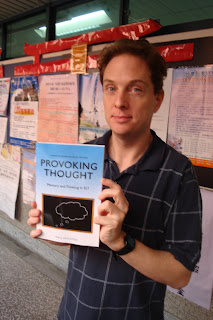
You can see here a picture of me with my book, standing in the hallway outside the Department of Applied English at Kainan University.
Thursday, November 19, 2009
two ads for Provoking Thought
In order to promote my new book, PROVOKING THOUGHT, I've put together a couple of short ads to get the word out. Here they are:
Provoking Thought ad 1
Provoking Thought ad 2
(Thanks to www.grapheine.com/bombaytv and www.grapheine.com/classiktv for their assistance with the two ads!)
Provoking Thought ad 1
Provoking Thought ad 2
(Thanks to www.grapheine.com/bombaytv and www.grapheine.com/classiktv for their assistance with the two ads!)
Wednesday, November 11, 2009
Creativity in ELT
Last night, I discovered this wonderful article on creativity and teaching:
The art of being creative
written by Marisa Constantinides. A well-written piece on how we can develop into more creative teachers. If you are interested in teacher training, you might also want to read her blog post over at Kalinago English:
How to Become an ELT Teacher Educator
The art of being creative
written by Marisa Constantinides. A well-written piece on how we can develop into more creative teachers. If you are interested in teacher training, you might also want to read her blog post over at Kalinago English:
How to Become an ELT Teacher Educator
Tuesday, November 10, 2009
Positive Psychology and ELT
I found a link to the following site on ELT News:
ELT and the Science of Happiness
which contains some interesting reading and activities. It's the creation of Marc Helgesen. I'm always looking for activities that involve an element of psychology, so I think this will be worth trying out in some of my classes.
ELT and the Science of Happiness
which contains some interesting reading and activities. It's the creation of Marc Helgesen. I'm always looking for activities that involve an element of psychology, so I think this will be worth trying out in some of my classes.
Saturday, October 03, 2009
Book preview
Humanising Language Teaching webzine has just published a book preview of my new book, Provoking Thought. It contains a brief description of the book, along with 6 activities. Take a look:
http://www.hltmag.co.uk/oct09/teach.htm
http://www.hltmag.co.uk/oct09/teach.htm
Friday, August 28, 2009
a couple of interesting things
I haven't added much to this blog lately, so I thought I'd post a couple of links that caught my eye.
The first is about a talk given by Ben Goldstein in April 2009 on the topic of "Breaking Taboos":
http://www.bengoldstein.es/blog/2009/04/breaking-taboos/
I'm sorry I missed the talk, but the handout and powerpoint are quite informative.
I also enjoyed this interview with Karenne Sylvester on TEFL Tradesman blog (Sandy McManus) :
http://tefltradesman.blogspot.com/2009/08/karenne-kalinago-answers-six-questions.html
I especially enjoyed her eloquent answer to question #6, What's wrong with the TEFL industry?
I'm now back in Taiwan, finishing up work on my second book. More on this subject next month.
Tuesday, June 16, 2009
More videos
I've discovered some new videos teachers out there might want to take a look at.
Here's Lindsay Clandfield talking about his books and his career:
http://www.youtube.com/watch?v=PlrH0o0bGpk
and this clip features Scott Thornbury and Luke Meddings describing their new book, Teaching Unplugged:
http://www.youtube.com/watch?v=MyMSeuvShJo
Gavin Dudeney and Nicky Hockly, the arch-enemies of hardline Dogme teachers the world over, explain here why technology is not SO evil:
http://www.youtube.com/watch?v=DsaROgjoQQI
Duncan Foord can be seen here talking about his book, The Developing Teacher:
http://www.youtube.com/watch?v=mo2jlBisMDo
Finally, here's Mario Rinvolucri letting us know about the future of English language teaching:
http://www.youtube.com/watch?v=kC13wAsCHLk
Subscribe to:
Posts (Atom)


 Posts


